When One vLLM Block Is No Longer One KV Page: LMCache PR #6019 Explained
A beginner-friendly explanation of KV cache blocks, kernel pages, why LMCache confused kernel paging with compression, how cache hits could silently restore the wrong KV, and how PR #6019 fixes every MP transfer path with num_blocks, k detection, and block-to-page expansion.
Maobaolong10/29/202624 min
Much of the KV-cache stack relies on an assumption that feels natural: when vLLM provides a block ID, the same number can index the first dimension of the KV tensor.
That assumption is valid for many backends. It breaks when an attention kernel uses pages smaller than vLLM’s configured block: one engine block ID then covers multiple consecutive tensor pages. If LMCache still treats a block ID as a page ID, the index can remain perfectly valid while pointing at the wrong KV. The second request appears to hit the cache, yet the model reads displaced history.
This is the correctness bug addressed by LMCache PR #6019. This article is based on head e2b0bf4d as of 2026-10-29. Rather than walking through the diff line by line, it builds the concepts, coordinate systems, misclassification, fix boundary, and compatibility behavior from first principles.
In one sentence: scheduling and chunk control remain in engine block IDs; only when the code reads or writes a tensor does it expand each block ID into every kernel page ID behind it.
1. Starting from zero: why KV cache uses blocks
When a language model produces a new token, attention needs the Keys and Values of earlier tokens. Recomputing all of that history on every decode step would be wasteful, so inference engines keep those intermediate states in GPU memory as the KV cache.
Requests have different lengths and finish at different times. Reserving one large contiguous allocation per request would waste memory. vLLM therefore divides the KV-cache pool into fixed-size blocks and uses a block table to map logical tokens to physical allocations:
The numbers 3 and 7 are not token positions. They are physical block IDs in the KV pool. LMCache receives the same kind of ID list for STORE and RETRIEVE.
Four terms must remain distinct:
token
One logical position in the input or generated sequence.
engine block
The allocation unit used by the vLLM scheduler and block table, named by a block ID.
kernel page
The physical page used by the attention backend to address the KV tensor; it may be smaller than an engine block.
slot
A place in the KV tensor that can hold one token's state. Physical layout determines the number of slots per page.
In the simplest case, the concepts align: one engine block covers 128 tokens, one tensor page has 128 slots, and block ID == page ID.
2. Where the mismatch comes from
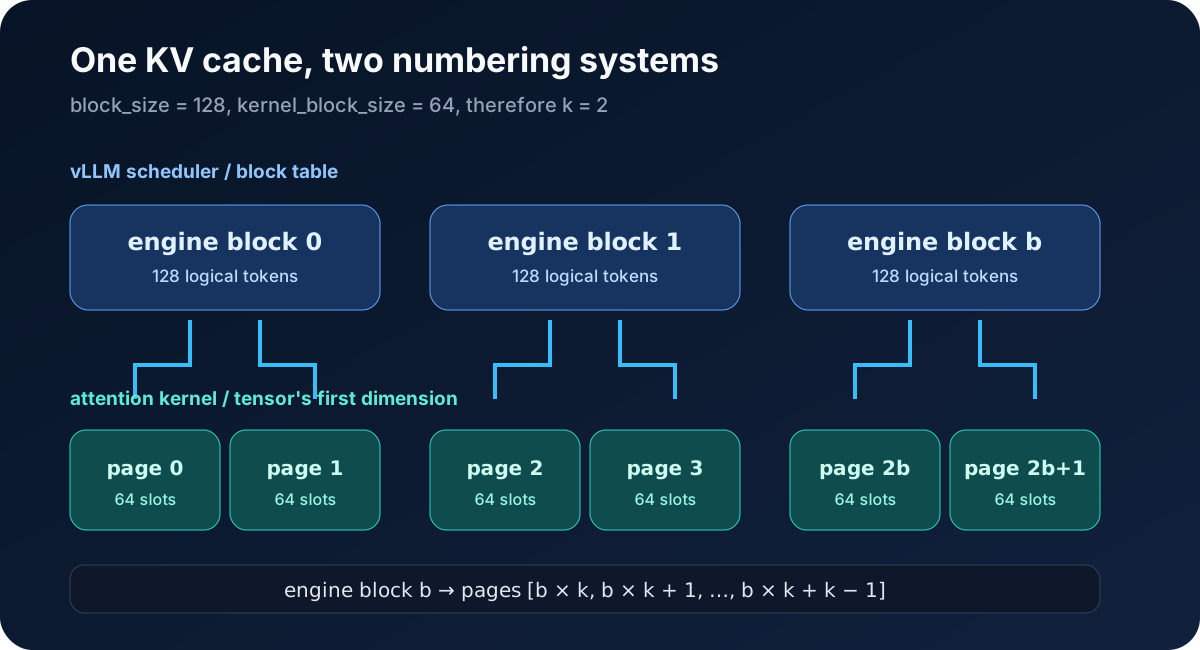
--block-size 128 says that one scheduler block covers 128 tokens. It does not guarantee that every attention kernel can use a 128-token page. A backend may support only a smaller kernel block size.
In the PR’s A10 reproduction, FlashInfer pages at no more than 64 tokens. Therefore:
Figure 1: The scheduler sees engine blocks; the transfer kernel sees tensor pages. Their IDs match only when k = 1.
In general, engine block b covers:
pages(b) = [b × k, b × k + 1, …, b × k + k − 1]
With k = 2, [3, 7] must become [6, 7, 14, 15]. It must not remain [3, 7].
Animation 1: the wrong and right way to address the same blocks
1 / 4
engine block ids
block 3
block 7
tensor page ids
page 2
page 3
page 6
page 7
page 8
page 13
page 14
page 15
vLLM sends block IDs [3, 7]. They describe two 128-token engine blocks, not two indices into the tensor's first dimension.
The old path treated 3 and 7 as page IDs. Both indices were valid, so the corruption could remain silent.
PR #6019 detects k = 2 and expands each block into consecutive pages: [3, 7] → [6, 7, 14, 15].
The transfer kernel finally receives page coordinates and moves the complete four-page representation of both blocks.
The dangerous part is that the wrong IDs are still valid. This is silent corruption, not necessarily a crash.
3. Why the old code mistook paging for compression
LMCache already had to model a different situation: slot compression. An engine block might represent 128 logical tokens while the tensor truly stores only 64 slots for it. In that case, tokens_per_block > slots_per_block really does imply a compression ratio.
Kernel paging looks similar if only one page is inspected: the page has 64 slots while the engine block represents 128 tokens. The missing 64 slots were not compressed away, however. They live in the next page.
slot compression: N engine blocks -> N tensor pages, each page has fewer slotskernel paging: N engine blocks -> N × k tensor pages, k pages tile one block
The old LMCache logic primarily inferred compression from tokens_per_block and the slots in one page. It did not know the number of blocks allocated by vLLM, so it could not validate the crucial whole-tensor relationship.
That produced three outcomes:
the CUDA-default LMCache-driven path interpreted the extra pages as compressed slots, moved only 1/k of a chunk, and used block IDs as page indices;
the engine-driven single-group path made the same silent mistake;
the engine-driven multi-group path classified the group as compressed and rejected it at startup.
The first two were more dangerous: inference still returned text, but a cache hit no longer matched the cold request.
4. The missing observation: carry num_blocks in registration
To distinguish compression from paging, LMCache needs four facts at once:
the number of physical pages in the tensor;
the number of block IDs allocated by the engine;
the number of slots in one page;
the number of logical tokens covered by one engine block.
The PR adds num_blocks to EngineGroupInfo. vLLM fills it from KVCacheConfig.num_blocks. Connector-owned auxiliary pools are not part of that block-ID space and continue to report 0.
The protobuf field is the new field 7, and the msgspec structure gives it a default of 0. Older senders that omit it remain decodable; 0 explicitly means “unreported.”
The detection rule is:
if engine_num_blocks > 0
and tensor_pages % engine_num_blocks == 0:
k = tensor_pages / engine_num_blocks
kernel_paged = (k > 1 and slots_per_page × k == tokens_per_block)
else:
k = 1 # compatibility fallback
This is stronger than guessing from a small page. Both the count relationship and the capacity relationship must close exactly.
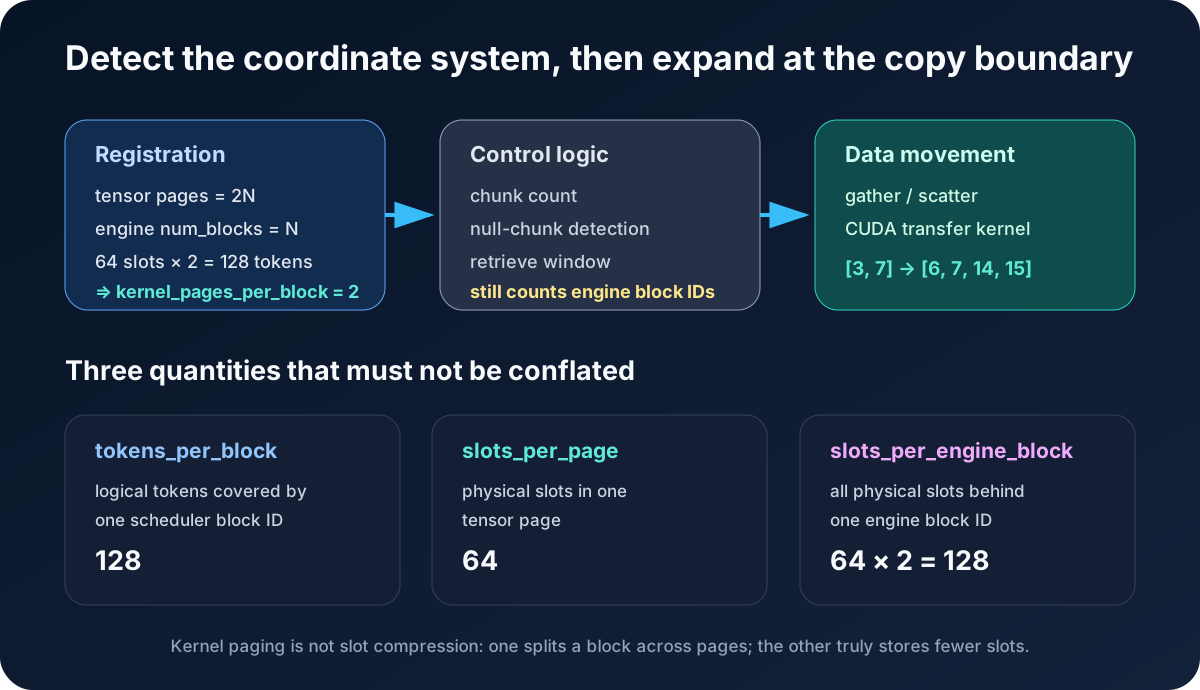
Figure 2: the PR does not convert the entire system to page coordinates. It converts once, at the boundary that actually indexes tensors.
5. The key design choice: do not expand too early
The fix is not “multiply every block count by k.” Some operations ask how many engine blocks a request has; others ask which pages a tensor copy must touch. Those questions belong to different coordinate systems.
Operations that remain in engine block IDs include:
the number of blocks in an LMCache chunk;
block-list underflow checks;
all-null chunk detection;
the number of chunks in a retrieve window;
cross-group chunk alignment.
Only when gather or scatter is about to index the tensor’s first dimension does the code call expand_block_ids_to_pages:
def expand_block_ids_to_pages(block_ids, pages_per_block):
    if pages_per_block == 1:
        return block_ids
    return [
        block_id * pages_per_block + offset
        for block_id in block_ids
        for offset in range(pages_per_block)
    ]
This boundary has two useful properties. A normal k = 1 backend retains the old behavior exactly. And chunk, window, null-mask, and multi-group synchronization retain the scheduler’s semantics instead of inventing additional logical chunks simply because physical paging is finer.
6. Why several transfer paths had to change
LMCache MP does not have a single copy entry point. The PR covers:
LMCache-driven store and retrieve;
engine-driven synchronous store, asynchronous store, and retrieve;
single-group and multi-group models;
inline and shared-memory transports.
The single-group path is particularly easy to miss. It bypasses much of KVLayerGroupsManager to reduce overhead. The PR therefore detects k separately in single-group registration, registers the correct number of pages per chunk, and expands IDs in the sync store, async store, and retrieve entry points.
Animation 2: how the fix crosses the transfer pipeline
1 / 4
1 · RegisterEngineGroupInfo.num_blocks → detect k
2 · Chunk controlcount engine block IDs
3 · Expand[3, 7] → [6, 7, 14, 15]
4 · Copygather / scatter tensor pages
physical pages moved
6
7
14
15
Registration observes both tensor page count and engine block count, producing kernel_pages_per_block = k.
Chunking, null masks, and windows continue to operate on original engine block IDs.
Block IDs are expanded into consecutive page IDs only at the gather / scatter boundary.
LMCache-driven, engine-driven, single-group, multi-group, sync, async, SHM, and inline paths all move the complete page set.
Expansion stays close to data movement instead of leaking into every scheduling operation.
7. Three details that are easy to misread
7.1 slots_per_block and slots_per_engine_block diverge
The PR keeps the physical slots in one page as shape_desc.bs / slots_per_block and adds the semantic quantity:
Compression ratios must use the latter. Otherwise two 64-slot pages that fully cover 128 tokens would still look like 2:1 compression.
7.2 calculate_num_blocks now counts tensor pages
The name can be misleading. For a kernel-paged group, its result is the number of pages the transfer kernel must process. Code that needs engine block count divides by kernel_pages_per_block.
7.3 A connector-side re-view is not a universal solution
For some known layouts, the connector can zero-copy re-view multiple pages as one logical block. That edit is safe only for layouts it understands. Handling page counts inside LMCache lets every layout supported by the format detector share the same rule without inventing a new shape rewrite for every backend.
8. What the validation demonstrates
The PR description reports end-to-end runs on an A10 with vLLM 0.32.0, --block-size 128, and LMCache chunk size 256.
Model / backend
Path
dev behavior
PR behavior
Qwen3-8B / FlashInfer
LMCache-driven
cache-hit text changed, no error
identical to cold request
Qwen3-8B / FlashInfer
engine-driven
inline hit changed
inline and SHM identical
Olmo-3-7B-Think / FlashInfer
LMCache-driven
repeated garbage text
identical to cold request
Olmo-3-7B-Think / FlashInfer
engine-driven multi-group
startup rejected compressed group
inline and SHM identical
FlashAttention controls with k = 1 retain their previous behavior. Tests also cover detection fallbacks, page expansion, null chunks still counted in blocks, store-to-retrieve round trips, and synchronous and asynchronous single/multi-group entries.
The important lesson is broader than those model names: a cache hit must not merely return successfully; it must agree with the cold result for the same request. Exception-only checks cannot detect silent corruption.
9. Compatibility boundaries and remaining limits
The fix deliberately preserves several boundaries:
num_blocks = 0 means the engine did not report a count. Detection falls back to k = 1, preserving old protocols but not magically discovering kernel paging;
detection requires an integral page-to-block ratio and slots_per_page × k == tokens_per_block; otherwise it refuses to guess;
auxiliary pools do not pretend to belong to vLLM’s block-ID pool and therefore leave num_blocks unset;
k = 1 returns the original block-ID list with no new mapping semantics;
this solves block/page coordinate mismatch, not arbitrary layout, quantization encoding, or recurrent-state inference.
Summary
PR #6019 is not merely about moving more pages. It makes explicit an abstraction boundary that matching integers had hidden:
Reusing the same number is convenient while the mapping is one-to-one. Once k > 1, that shortcut becomes a correctness bug. num_blocks gives LMCache enough evidence to identify the coordinate system, kernel_pages_per_block preserves the ratio, and expand_block_ids_to_pages confines conversion to the actual data-movement boundary.
That yields a general systems lesson for KV caches, paged storage, and cross-process GPU transfer: two layers using the same integer today does not make that integer the same identity.