Detailed Explanation of LMCache MP Registration Path: What Exactly Does register_kv_cache Do?
This article systematically explains why LMCache requires this layer of registration protocol, focusing on the KV cache passed after calling register_kv_caches in vLLM, client handling of the LMCache-driven multiprocess connector, server registration, EngineGroupInfo generation, and the complex model layouts of standard Attention, MLA, DeepSeek, Qwen, and Mamba.
Maobaolong9/16/2026Updated 9/18/202635 min
If you only look at the function name, register_kv_cache seems like a very ordinary initialization step: vLLM tells LMCache about the KV cache, and LMCache notes it down for later use.
However, in the multiprocess connector of LMCache, this registration action is actually the “modeling moment” of the entire GPU KV transfer path.
Subsequent actual STORE / RETRIEVE requests typically won’t carry the complete tensor structure, nor will they re-guess the shape, dtype, stride, block size, and group relationships of each layer of the KV cache every time. They will only carry lightweight information such as token range, cache key, block id, and event handle. The server can translate this lightweight information into the correct GPU copy because the register_kv_cache phase has already established the most important details:
What KV tensors are present in the vLLM worker;
How these tensors are exposed to the LMCache server via IPC handles;
The actual physical layout of each tensor;
Which layers can share the same transfer kernel;
How vLLM’s block id is grouped by engine group;
How many logical tokens a block id covers, and how many slots a physical tensor page has;
Which groups are sliding-window, Mamba recurrent state, or connector private aux pool, and which should not be reused by the prefix cache.
This article only discusses the LMCache driven mode: the vLLM worker exports the KV cache’s device handle, and the LMCache server directly reads and writes the worker’s KV buffer through these handles. The engine driven mode will not be elaborated on here.
This article is based on the review of LMCache PR #5042 dated 2026-09-16, with the head being e3cffcf, and the title is [Feature][MP] Support GLM-5.3-Flash and Qwen3.8-Flash-Next. If the PR continues to evolve, please refer to the current code.
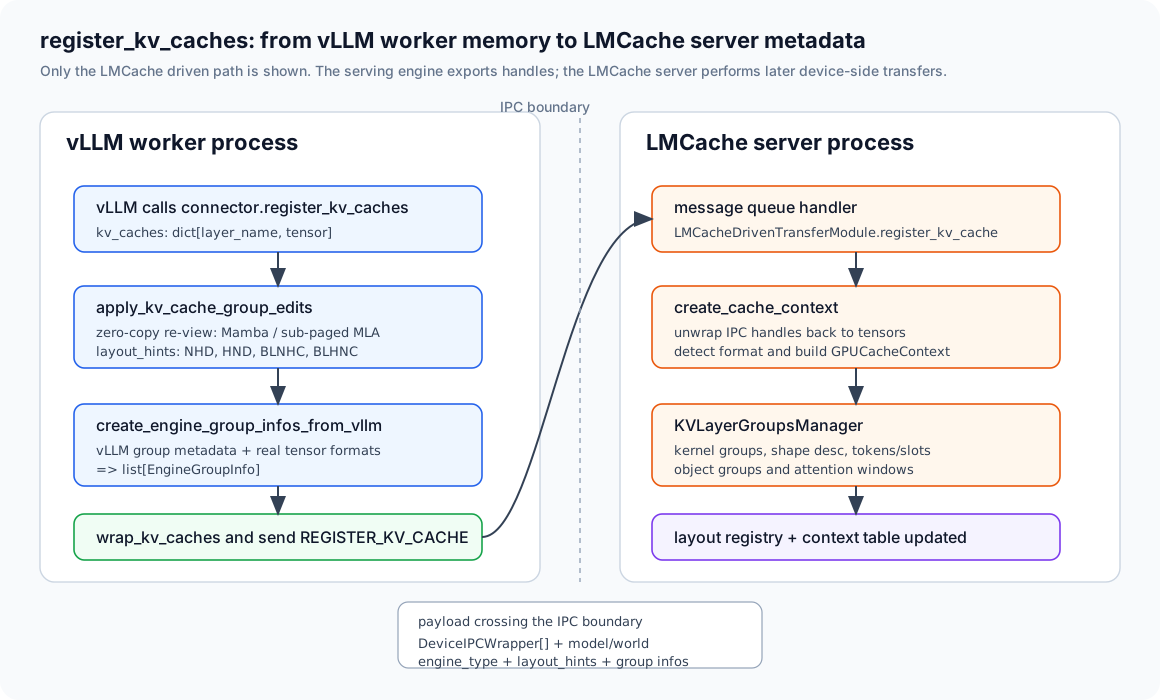
Figure 1: LMCache driven registration path. The client first standardizes the tensor view, generates EngineGroupInfo, and then sends the IPC wrapper and group metadata to the server.
Animation 1
The registration path is not a single message send, but a step-by-step modeling of runtime resources
Step 1 / 6
The vLLM worker first obtains the actual KV tensor, KVCacheConfig, and layout hints; all subsequent lightweight STORE / RETRIEVE operations will rely on the contract established during this registration.
Zero-Copy Re-ViewChange sub-paged / Mamba views into pages that can be transported by block
EngineGroupInfoCombine vLLM group semantics and actual tensor layout into a protocol
REGISTER_KV_CACHE PayloadDeviceIPCWrapper[] + model/world + layout_hints + group infos
IPC Boundary
LMCache Server
Import IPC HandlesUnwrap into tensor views visible to the server process
Reproduce Format DiscoveryRe-detect shape/stride according to the layer index specified by EngineGroupInfo
Runtime Transfer ResourcesKVLayerGroupsManager + layout registry + context table
This animation corresponds to the four layers of transformation: memory ownership, layout, semantic grouping, and storage object description. Missing any step means the server cannot safely transport based solely on block ids.
## 1. Clarifying the Scene
Large model inference is typically divided into Prefill and Decode.
In the Prefill phase, the prompt is read in at once, and the model computes the Key and Value for each token at every layer of attention. The Decode phase continues to generate new tokens, where the attention of the new tokens needs to read historical Keys/Values. If the historical prompt is recalculated at every step, the cost is very high, so the inference engine stores these intermediate results in GPU memory, which is known as the KV cache.
To efficiently manage the KV cache, vLLM divides consecutive tokens into pages, often referred to as blocks. The logical token sequence requested is mapped to a set of block IDs via a block table. Here’s a very common example:
block_size = 16tokens 0..15 -> block id 10tokens 16..31 -> block id 11tokens 32..47 -> block id 25
Here, the block ID is not the token ID but rather the page number in the vLLM KV cache pool. The attention kernel finds the corresponding KV page for each token through the block table.
What LMCache needs to do is store these precomputed KV caches in an external caching layer, and when the same prefix is encountered later, retrieve it back to write into vLLM’s KV buffer. This raises a question: the KV buffer of vLLM is in the GPU memory of the vLLM process, while the LMCache server is another process. The server cannot know where the tensors in the worker process are located, nor can it guess how to move them during each STORE operation.
Thus, a cross-process contract must be established during the registration phase:
Where are the KV tensors for this batch of layers?What do they look like?Which tensor pages should the block IDs sent by vLLM correspond to?How should the chunks in the LMCache storage object map back to these pages?
This is the core value of the register_kv_cache path.
2. What is Passed to LMCache After vLLM Calls
On the vLLM worker side, the register_kv_caches method of the LMCache connector is called. In the current PR code, the entry point is in lmcache/integration/vllm/lmcache_mp_connector.py:
The key is the layer name, such as model.layers.0.self_attn.kv_cache; the value is the corresponding KV cache tensor for that layer. For some Mamba/linear attention layers, the value may also initially appear as a tensor list like [conv_state, ssm_state], which will later be re-viewed into a page tensor that LMCache can handle after registration edits.
In addition to the actual tensors, LMCache will also read the KVCacheConfig from vLLM. The most critical part is kv_cache_groups. This group is not arbitrarily defined by LMCache but is defined by the vLLM scheduling side:
The kv_cache_spec contains information such as block_size, attention type, sliding window size, Mamba cache mode, the number of states in MLA, and whether it is prefix_cacheable, among other details. In other words:
kv_caches indicates “what the actual memory looks like”;
kv_cache_config.kv_cache_groups explains “how vLLM’s scheduling and block IDs understand this batch of memory”;
layout_hints indicates what KV layout vLLM has chosen, such as NHD, HND, BLNHC, BLHNC.
The first thing register_kv_caches does is combine these three pieces of information.
3. Who Moves Data in LMCache Driven Mode
The LMCache driven mode can be understood as follows:
vLLM worker: I have KV cache GPU memory. I package this batch of tensors into IPC handles and send them to the server.LMCache server: I import these handles to obtain tensor views that point to the worker's KV buffer. For subsequent STORE operations, I copy from the worker's KV buffer to the LMCache temp buffer/storage. For subsequent RETRIEVE operations, I write back from the LMCache temp buffer/storage to the worker's KV buffer.
Thus, during the client registration phase, LMCacheDrivenTransferContext is created. This context first checks whether the device where the KV cache resides supports event IPC, and then calls the request client:
Note that what is sent here is not the ordinary tensor itself. Cross-process communication cannot directly send Python tensor objects. wrap_kv_caches(kv_caches) will package the tensor into a DeviceIPCWrapper. This can be understood as “an importable handle for this device memory + reconstruction information such as shape/stride/storage offset.”
The payload of the registration request roughly contains the following items:
Field
Meaning
instance_id
The current worker instance, generally understood as the registration identity of a GPU worker
kv_cache
A list of DeviceIPCWrapper, which the server uses to import the worker’s KV memory
model_name
Cache key and layout registry must be distinguished by model
world_size
Part of the parallel configuration, which also affects the cache key and layout
engine_type
Here it is vLLM, used for server format detection
layout_hints
vLLM provides layout clues to LMCache
engine_group_infos
Neutral grouping protocol generated by LMCache from vLLM group + tensor layout
This is why registration is not merely a “notification.” It actually connects the GPU memory of the vLLM worker to the transfer runtime of the LMCache server.
4. Client Step One: Why KV Cache Group Edits Must Be Done Before Registration
apply_kv_cache_group_edits is a very important background point in PR #5042. It performs zero-copy re-view.
Zero-copy means: no copying of KV bytes, only changing the tensor’s shape/stride view, allowing LMCache’s subsequent format detection and transfer kernel to understand it using the same set of rules.
Why is re-view necessary? Because the block ID granularity on the vLLM scheduling side and the physical page granularity actually used by the worker’s attention kernel are sometimes not the same.
One vLLM block corresponds to one tensor page. At this point, LMCache can directly look at the tensor shape to know how many token slots are in a page.
However, hybrid/MLA/Mamba models break this intuition.
First, Three Terms: Page Size, Logical Block, Physical Block
The most confusing terms here are block_size and page_size. In the vLLM KV cache spec, block_size refers to “how many tokens/states a block manages”; page_size_bytes refers to “how many bytes such a page actually occupies.” Therefore, page size is not the number of tokens, but the size of memory.
For ordinary attention, a token’s cache roughly contains two vectors, K and V:
But Mamba/recurrent layers are different. They do not cache “one row of K/V for each token,” but rather a set of recursive state snapshots, such as conv state, SSM state, along with possible padding. The size of a Mamba page is mainly determined by the shapes and dtypes of these state tensors, not simply multiplying the number of attention token rows.
The Mamba-hybrid model has both attention groups and Mamba groups. The vLLM hybrid memory allocator needs to place these groups into the same KV cache grouping, capacity estimation, and block table system, so it hopes to align the page_size_bytes of different groups. Here, “alignment” refers to byte-level page size alignment, not requiring each group to cover the same number of tokens.
Intuitively, the allocator and scheduler will continuously ask questions like: how many pages can each group still allocate, which page corresponds to the N-th block ID of a request in each group, and how much concurrency can be supported under a given memory budget. If “one page” of different groups represents completely different byte amounts, unified estimation and bookkeeping of block IDs will become very difficult to maintain, and it may even lead to miscalculating the number of pages for a certain group.
Why would the logical block size of attention be enlarged? Because the bytes of the attention page can be increased by enlarging the block size, while the bytes of the Mamba state page are often already determined by the state shape. Suppose the attention kernel naturally uses a 32-token page, with a size of X; the Mamba state page is approximately 17X. To align the page sizes of the two groups, vLLM can enlarge the attention manager block size from 32 to 544:
natural attention kernel page: 32 tokens -> X bytesMamba state page: 1 state -> 17X bytesaligned attention logical page:544 tokens -> 17X bytes
The block ID unit recognized by vLLM scheduling and cache management. In the above example, one logical block covers 544 token slots.
physical block / kernel page
attention backend kernel, actual worker tensor
The tensor page unit that the kernel actually reads and writes. In the above example, the kernel still accesses 32-token pages.
Thus, “544-token logical block” does not mean that the FlashAttention kernel suddenly processes a 544-token page at once. More accurately, it means that the scheduling layer of vLLM treats 17 consecutive 32-token kernel pages as the same manager block:
There is a very important configuration constraint: if the tokens_per_block of this cacheable group is indeed 544, then the chunk_size of LMCache cannot continue to use the default of 256. The current MP path requires that the LMCache chunk size must be a multiple of the tokens_per_block of each cacheable group, because an LMCache chunk cannot be split in the middle of a vLLM logical block. That is to say:
tokens_per_block = 544chunk_size = 256 -> Not allowed, should directly report an error during registrationchunk_size = 544 -> Allowed for this group, one LMCache chunk holds 1 logical blockchunk_size = 1088 -> Allowed for this group, one LMCache chunk holds 2 logical blocks
If the same model has other cacheable groups, for example, another group with tokens_per_block of 64, then chunk_size must also be a common multiple of both 64 and 544. The actual configuration usually takes the least common multiple of the positive tokens_per_block of all cacheable groups; temporary groups with prefix_cacheable = False do not participate in this constraint because tokens_per_block = 0.
Thus, the example of 544 does not imply that “the default 256 can also save a 544-token block,” but rather indicates that hybrid/page-size alignment may enlarge the minimum cacheable registration granularity. In real deployments, either set the LMCache chunk_size to be a common multiple of all cacheable groups’ tokens_per_block, or the model cannot be correctly registered according to the current MP prefix KV path.
This also answers another common question: is it impossible to save fewer than 544 tokens in LMCache? Under such configurations, in terms of a complete prefix chunk, yes, a prefix with fewer than one LMCache chunk will not form a reusable complete cache object. However, this does not mean that the current request cannot decode, nor does it mean that there are no KV in the vLLM GPU memory; it simply cannot be safely accessed as a complete chunk reusable across requests. The reusability granularity of LMCache is determined by chunk_size, which must align with the logical block boundaries of the engine group.
Animation 2
How 17 Physical/Kernel Pages Become 1 Logical Block
Step 1 / 5
The worker tensor initially counts kernel pages, each page containing only 32 token slots; the vLLM block ID cannot yet be directly used as a 544-token block.
This animation intentionally does not depict K/V semantics, but rather address semantics: LMCache is concerned with how the same segment of storage is re-labeled as a byte range understandable by vLLM block IDs.
This is also why LMCache registration cannot only look at the first dimension of the raw tensor. The first dimension of the raw tensor may count kernel pages, but the block IDs passed down by vLLM belong to the logical block coordinate system. LMCache must first re-view multiple physical pages into one logical page; otherwise, subsequent STORE/RETRIEVE operations will incorrectly map block IDs to byte ranges.
1. Sub-paged Attention
With the above concepts, Sub-paged attention is easier to understand: it refers to a logical attention block on the vLLM scheduling side being split into multiple smaller physical/kernel pages for storage.
Thus, the worker tensor may look like this:
[num_kernel_pages, 2, 32, num_heads, head_size]
Here, 32 is the actual number of kernel page tokens used by the attention backend. However, the block ID given to LMCache by vLLM is still the ID of a 544-token logical block. One logical block actually occupies 17 consecutive kernel pages:
If LMCache directly treats this tensor as a block size of 32, it will misunderstand the block ID coordinate system. The solution is to re-view the 17 kernel pages as 1 logical page:
The original first dimension counts 32-token kernel pages. The vLLM block ID counts 544-token logical blocks. Since 544 / 32 = 17, 17 consecutive kernel pages combine into 1 logical block. Here, num_kernel_pages must be divisible by 17.
2
2
This dimension is retained to allow the general KV transfer behind LMCache to still see a rank-5 shape with kv_size = 2. Note that after re-viewing, it no longer reliably represents the “pure K plane / pure V plane of the entire logical block.”
32
544
The original 32 is the number of token slots in the kernel page; the new 544 is the logical block size recognized by the vLLM scheduler. When LMCache subsequently moves by block id, it needs to see the 544-token block coordinates, not the 32-token kernel page coordinates.
H
1
The original H is the actual number of attention heads. However, the goal of this view is not to let LMCache understand the semantics of each head, but to allow the bytes of an entire logical page to be treated as a movable payload. The code uses 1 synthetic head.
C
C'
The original C is the width of each head. Since H is collapsed to 1, the content originally spread across H * C will be packed into the new trailing width. In simple cases, C' = H * C; the actual code calculates it using spec.page_size_bytes / element_size / (2 * 544 * 1) to ensure the number of elements per page matches exactly.
So this view is not reinterpreting the mathematical semantics of attention, but establishing an address view of “block id to byte range.” It requires the raw tensor to be contiguous; it does not move any bytes but simply marks the same segment of storage with a new shape. As long as STORE and RETRIEVE use the same view, bytes can correctly round-trip. However, this also means that after re-viewing, kv_caches[:, 0] can no longer be treated as a pure K tensor for content-aware processing, as K/V may have already been interleaved in this opaque payload at the kernel-page granularity.
2. Sub-paged MLA
The MLA cache is typically not a standard K/V with two planes. It resembles a key-only or latent state cache, where one row of state can serve multiple logical tokens. PR #5042 focuses on MLA caches like GLM / Kimi: the worker kernel uses smaller pages, and LMCache needs to combine multiple kernel pages into a single logical block view.
For example, Kimi K3, a rank-3 MLA cache:
raw worker tensor:[N * 12, 64, 576]meaning:Every 64 rows of state constitute a kernel page.12 kernel pages combine to form a logical block on the vLLM scheduling side.edited view:[N, 768, 576]
Here, rank-3 simply means the tensor has 3 dimensions: [num_blocks, states, hidden]. Common K/V attention is typically rank-5: [num_blocks, 2, block_size, num_heads, head_size].
PR also supports rank-4 MLA:
[NB, 1, states, C] # head slot before states, similar to HND[NB, states, 1, C] # head slot after states, similar to NHD
The 1 is a single head slot. MLA at the LMCache transfer layer is often viewed as a key-only format with kv_size = 1 and num_heads = 1; that head dimension is merely to adapt to the general kernel description and does not represent the multi-head K/V of a typical MHA.
3. Mamba state page
Mamba / Gated DeltaNet recurrent layers do not store K/V for each token but rather recursive state snapshots. In the old path, a Mamba layer might register as:
[conv_state, ssm_state]
The two tensor shapes and dtypes may differ, but they actually share a padded page:
conv bytes | ssm bytes | padding
The LMCache transfer path is better suited for handling tensors where “each block is one page,” so before registration, the Mamba page is re-viewed into an opaque page similar to attention:
[num_blocks, 2, block_size, 1, head_size]
Here, the 2 is not true K/V; it merely slices a whole page of bytes into a shape that the transfer kernel can handle. PR #5042 also adds support for a unified Mamba view for BLNHC / BLHNC: blocks-first layout and the original layers-first layout can be reduced to the same inner shape selection in this view.
Animation 3
Why Mamba state can also use register_kv_cache
Step 1 / 5
Mamba / linear attention saves a recurrent state snapshot, not a K/V for each token. Here, conv_state and ssm_state are treated as two segments of differently shaped bytes.
The focus of the Mamba animation is on the "state page" rather than "K/V semantics": the registration phase unifies multiple segments of state bytes into an addressable page and encodes recovery semantics into EngineGroupInfo.
## 5. Client Step Two: `create_engine_group_infos_from_vllm` is the Translator for the Entire Link
First, let’s clarify the name: create_engine_group_info_from_engine is not the function name in the current code of this PR; it is more like a “generic term” or an old singular reference that is easy to say during discussions. The actual entry point in the current code is:
create_engine_group_infos_from_vllm(...)
It is called by LMCacheConnectorV1Impl.register_kv_caches in lmcache/integration/vllm/kv_cache_groups.py. There are three noteworthy words in the function name:
Name Fragment
Meaning
infos
The return is not a single info, but a group of infos: list[EngineGroupInfo]
from_vllm
This refers to the KVCacheConfig / KVCacheGroupSpec of vLLM, not an engine-neutral abstract object
EngineGroupInfo
A single element describes a transfer/kernel group in the LMCache protocol and which serving-engine block-id group it comes from
Why must it be list[EngineGroupInfo]? It cannot be summarized with just “a vLLM group may be split into multiple LMCache kernel groups.” That is merely one of the most common reasons. In the current code, the number of infos returned ultimately depends on how many transfer identities are produced by group_layers_by_identity(...); this identity includes:
Thus, list[EngineGroupInfo] may vary in length, shorten, or remain empty due to the following situations:
Situation
What Happens
Why
vLLM already has multiple engine groups
Typically produces multiple EngineGroupInfo
Different vLLM engine groups are in different block-id address spaces; even if tensor shapes are the same, block ids cannot be mixed
Different physical layouts within the same vLLM engine group
An engine_group_id may split into multiple EngineGroupInfo
For example, the main KV is rank-5 K/V, while the indexer is rank-3 key-only; they share the same block id list but have different copy kernel shapes
Different shape/dtype/head configurations within the same engine group
Continue to split by identity
Any difference in kv_size, num_heads, head_size, slots_per_block, or dtype may require different kernel descriptors
Non-hybrid cases without vLLM group metadata
May also return multiple infos
When per_layer_engine_group_idx is None, all layers are treated as engine group 0; however, if the actual tensor layouts differ, they will still be split by physical identity
CacheBlend registers a connector’s private aux pool
Will add synthetic engine groups
The aux pool is not a native vLLM group, but it also requires independent format discovery, registration, and transfer, thus generating additional group ids with extra_object_group_tag
Scratch / prefix_cacheable = False groups
Will not produce EngineGroupInfo
These are temporary ring buffers within requests and do not belong to reusable prefix KV; the code uses tokens_per_block = 0 to indicate exclusion
Cross-layer KV sharing / alias layers
Related layers will be excluded
If some layers’ KVs are actually held by the owner layer, duplicate registration may lead to redundant transfers or incorrect block-size calculations
There are also some fields that will affect the content of EngineGroupInfo, but they do not necessarily create new infos independently. For example, DCP will change the attention’s tokens_per_block; sliding-window will write sw_size_tokens; Mamba / linear attention’s state snapshot will write recurrent_state. They will continue to affect the server’s object group, window semantics, and block count calculations, but whether an additional info is created still depends on whether the engine group id and physical transfer identity are separate.
The problem it aims to solve is: the vLLM group and the LMCache transfer group are not the same concept.
The vLLM engine group is concerned with scheduling semantics:
These layers share the same cache spec.The block ids of these layers belong to the same paged-block address space.
The LMCache kernel group is concerned with transfer semantics:
Can these layers use the same copy kernel?Are their kv_size, num_heads, head_size, slots_per_block, dtype, engine_kv_format the same?Do their block id coordinate systems match?
Thus, the responsibility of create_engine_group_infos_from_vllm is not to “copy vLLM groups,” but to synthesize the two sets of information into a protocol that can also be reproduced by the server.
1. First, Establish a Mapping from Layer Name to Tensor Index
kv_caches is an ordered dict. The function first converts it into a list and records which tensor corresponds to each layer name:
per_layer_discoverable_kv_caches = list(kv_caches.values())layer_to_idx = {name: idx for idx, name in enumerate(kv_caches.keys())}
All subsequent group metadata will be converted from layer names to layer indices. For example, if the 0th, 2nd, and 4th tensors in the registration list belong to the same vLLM group, when the server receives EngineGroupInfo(layer_indices=(0, 2, 4)), it does not need to recognize the vLLM layer names; it just needs to work based on the indices of the registered tensor list.
Dynamic Figure 4
From Layer Name to Layer Index, Then to EngineGroupInfo
Step 1 / 5
First, flatten the ordered dict into a registered tensor list; from this step onward, the cross-process protocol will try to only discuss indices, no longer requiring the server to understand vLLM layer names.
Registered Tensor List
0model.layers.0.self_attn.kv_cacherank-5 K/V
1model.layers.1.qsa_ringprefix_cacheable = false
2model.layers.2.self_attn.kv_cacherank-5 K/V
3model.layers.3.mla_indexerrank-3 uint8
4model.layers.4.self_attn.kv_cacherank-5 K/V
vLLM Group Metadata
Group 0: Layer Names[layer.0, layer.2, layer.4]
Group 1: Non-Prefix-Cacheable[layer.1] → tokens_per_block = 0
(0, 2, 4) here is the result of this small example: it comes from the positions in the registered tensor list, without requiring the model to actually register only even layers.
2. Identify Layer Groups Needing Format Discovery
Format discovery is the process by which LMCache determines the KV format based on the actual tensor shape/stride, for example:
PR #5042 added a crucial logic here: scratch groups do not participate in format discovery.
Scratch groups are those marked prefix_cacheable = False by vLLM. They are not reusable KV for token prefixes but temporary ring buffers during the request lifecycle. Since they will not be stored/retrieved later, their unusual layout should not cause registration failures.
Thus, the code constructs layer_index_groups like this:
layer_index_groups = [ [layer_to_idx[name] for name in group.layer_names] for group in vllm_groups if not is_scratch_spec(group.kv_cache_spec)]
The is_scratch_spec check is quite straightforward: if the spec has prefix_cacheable and is false, it is considered not part of the prefix cacheable KV. Older versions of vLLM that do not have this field are handled by default according to the token-paged spec.
3. Perform Format Discovery for Each Tensor Group, Allowing Different Layouts Within the Same vLLM Group
normalized_kv_caches is the tensor view processed by contiguous-view recovery/detector; engine_kv_formats is the LMCache native format corresponding to each layer.
Why per-layer format? Because a vLLM group may simultaneously contain both regular K/V caches and MLA indexer caches. They may belong to the same UniformTypeKVCacheSpecs group on the scheduling side, but their physical tensor formats are entirely different:
If only one format is assigned to the entire model or the entire vLLM group, it may treat the indexer as a regular K/V or vice versa. The related tests in the PR specifically cover scenarios where “a group mixes rank-5 K/V and rank-3 key-only MLA index caches.”
This step is particularly interesting. The default is not “all layers go into group 0,” but rather “unless vLLM explicitly states that this layer belongs to a cacheable group, exclude it first.”
Why? Because some models perform cross-layer KV sharing. For example, in certain multi-backbone or shared KV structures, a layer’s KV may actually alias to another owner layer’s KV tensor; the vLLM’s kv_cache_groups only lists cache-owning layers. Shared layers should not form their own LMCache group, or else it would lead to redundant transfers and potentially incorrect block id counts due to inconsistent block sizes.
Here, tokens_per_block is a crucial logical quantity: how many logical tokens a vLLM block id covers.
Under regular attention:
tokens_per_block = spec.block_size
In DCP scenarios, the scheduler coordinates of the attention group will be scaled according to dcp_size:
tokens_per_block = spec.block_size * dcp_size
Mamba recurrent state is a copy-style state and does not scale this dimension according to DCP shards, so it retains spec.block_size.
For scratch groups, it is:
tokens_per_block = 0
0 here is a marker: this group does not cover cacheable prefix tokens. When the function encounters 0, it will not fill its layer into per_layer_group_idx, and ultimately, it will not form any EngineGroupInfo.
5. Parse Sliding-Window and Recurrent-State Information
The same layer index mapping will also be used for two auxiliary attributes:
per_layer_sw_sizeper_layer_recurrent
Sliding-window attention retains only the historical KV within a window range. When LMCache accesses chunks, it needs to know whether this group can only look at a limited window across chunks. The align/all cache mode of Mamba / linear attention saves a recurrent state snapshot, and the recovery semantics resemble a one-block window: what is truly useful upon a hit is the state of the last matching block.
Thus, EngineGroupInfo will carry:
sw_size_tokensrecurrent_state
This will continue to affect the server’s object group and attention window descriptor.
6. CacheBlend Aux Pool Will Generate Synthetic Engine Group
CacheBlend may register a connector’s private aux page pool, named like:
cb.aux_pool.<tokens_per_block>[.<label>]
It is not a native vLLM group, but it also needs to participate in registration, format discovery, and subsequent access. Therefore, the function will place it after vLLM groups, generating a synthetic engine group and marking it with extra_object_group_tag.
This detail indicates that EngineGroupInfo is not a “mirror of the original vLLM group.” It is the protocol view of LMCache: it can accommodate both vLLM groups and the additional page pools needed by the connector.
7. Finally, Split Again by Physical Transfer Identity
The server will subsequently create a kernel group: all layers use the same shape descriptor, and a STORE / RETRIEVE request will launch a type of copy kernel for this group.
This is the most basic “one vLLM block one tensor page”:
block id 10 -> tensor page 10 -> 16 token slots
tokens_per_block == slots_per_block, with no compression or re-view.
2. Ordinary MLA
The KV cache of MLA may not necessarily have both K and V planes like ordinary attention. A common key-only MLA can be:
If tokens_per_block == slots_per_block, it is merely a different format, not compression.
3. DeepSeek-V3.2 Type fp8_ds_mla
Paths related to DeepSeek-V3.2 can be misleading because it also has MLA and a strong sense of compression in its name. However, it is important to distinguish between two types of “compression”:
One is slot compression: multiple logical tokens share one physical state slot, indicated by tokens_per_block > slots_per_block;
The other is smaller bytes per slot: for example, a certain fp8 layout reduces the bytes per slot, but one logical token still corresponds to one state slot.
The PR document mentions that DeepSeek-V3.2’s fp8_ds_mla is closer to the latter: it compresses the bytes representation of each slot rather than stuffing multiple tokens into one slot. Therefore, the spec side can usually still maintain:
For register_kv_cache, this means it does not need to be misprocessed by sub-paged view and should not be treated as DeepSeek-V4 style slot compression. Format detection and dtype/shape descriptor will reflect its true byte layout.
4. MLA with Indexer
Models with an indexer are more complex because there may be two types of physical caches within the same vLLM group:
They may share a UniformTypeKVCacheSpecs group because the scheduling side wants them to use the same engine block-id address space. However, LMCache transfer cannot combine them into one kernel group: the width, dtype, and even the number of states per block are different.
Thus, normalize_and_discover_per_layer_formats will separate detection within the group by tensor shape, and group_layers_by_identity will further split them into different EngineGroupInfo due to differences in head_size / dtype / engine_kv_format:
info 0: engine_group_id = 0 layers = main MLA layersinfo 1: engine_group_id = 0 layers = indexer layers
Note that both infos can share the same engine_group_id. This indicates they read the same vLLM block id list, but the transfer kernels run separately.
5. DeepSeek-V4 and Other Multi-Backbone / Multi-Group Structures
Models like DeepSeek-V4-Flash push the problem a step further: different groups can have different tokens_per_block, and some groups may also have slot compression.
For example, the following conceptual structure may appear:
This is also why EngineGroupInfo needs to include tokens_per_block, and the server’s KVLayerGroupsManager must re-detect slots_per_block from the actual tensor.
As for multi-backbone or cross-layer KV sharing, the core issue is not compression, but that certain layers do not have independent KV owners. vLLM may only place the cache-owning layer into kv_cache_groups, while other layers alias to the owner’s KV cache. The default strategy of LMCache is to mark layers not explicitly covered by the vLLM group as EXCLUDED_ENGINE_GROUP, preventing them from forming their own transfer group. This is because the KV of the owner layer only needs to be moved once.
6. PR #5042’s Qwen3.8B / GLM Scratch Group
One of the core additions in PR #5042 is to exclude groups with prefix_cacheable = False from the prefix KV registration path.
Models like Qwen3.8-Flash-Next may have QSA compressor rings, and GLM-5.3-Flash may also have structures like kpool tails. The common points of these buffers are:
They are temporary states within requests;Typically overwritten by pos % capacity;vLLM does not treat them as prefix cache recovery;They do not represent a token prefix that can be reused across requests.
If LMCache treats them as ordinary groups, two problems will arise.
First, the token span on the scheduling side will be lowered. For example, an ordinary group may cover 1600 tokens in one block, while the scratch ring capacity is only 8. If the minimum value is uniformly taken, LMCache will assume that the prefix can only be stored aligned to 8 tokens, thus disrupting the actual store chunk logic.
Second, the layout of the scratch tensor may not be supported by the LMCache transfer kernel. Since it does not need to transfer, format discovery should not fail here.
The handling in the PR is an end-to-end exclusion:
is_scratch_spec(spec) -> prefix_cacheable == Falseget_tokens_per_block(spec) -> 0format discovery -> skip this groupper_layer_group_idx -> remains EXCLUDED_ENGINE_GROUPEngineGroupInfo -> no entry emittedslice_block_ids_per_group -> tokens_per_block 0 yields empty block list
Therefore, a more accurate term should be non-prefix-cacheable KV cache group. The scratch ring is a current example; it is inappropriate to label all cases as scratch layers because what is excluded is the cacheable semantics of the group, not the semantics of a specific Transformer layer.
7. PR #5042’s Sub-Paged MLA Rank-3 / Rank-4
The PR also extends _SubpagedMLAAttentionViewEdit to rank-4 and allows it to use spec.num_states or the older version of block_size / compress_ratio to determine the number of logical states.
This addresses situations like GLM-5.3-Flash:
block_size = 1152sparse MLA: kernel rows = 64 logical states = 1152 ratio = 18kpool indexer: tokens_per_state = 4 logical states = 1152 / 4 = 288 kernel rows = 32 ratio = 9
They may be in the same UniformTypeKVCacheSpecs group, but each layer’s leaf spec is different. Therefore, the PR changes the edit to match per-layer specs rather than applying a one-size-fits-all approach to the entire group’s outer spec.
8. PR #5042’s Mamba Unified View and BLNHC / BLHNC
In the new vLLM layout, blocks-first BLNHC / BLHNC may appear. For the Mamba unified state, the input looks more like:
[num_blocks, 1, 1, row]
Where row is an entire row of the recurrent state for this layer, and stride(0) is the size of the padded page that each block skips. LMCache needs to view it as:
The key judgment in the PR is that for this Mamba view, blocks-first and layers-first can be categorized similarly in terms of inner dim selection; BLNHC resembles NHD, and BLHNC resembles HND.
9. PR #5042’s Contiguity Recovery Tie-Break
Another seemingly small but crucial modification in attempt_permute_to_contiguous_view is:
This function attempts to reorder dimensions by stride from largest to smallest, trying to restore a permuted tensor to a physically contiguous layout. The problem is that size-1 dimensions often have the same stride as adjacent dimensions. For example, a BLNHC view with only 1 KV head may have:
Both the head dimension and the token dimension stride are HS. If the unstable sorting places the size-1 head before the token, LMCache may get [NB, 1, BS, HS]; however, a more physically reasonable contiguous view would be [NB, BS, 1, HS].
The tie-break condition shape[i] != 1 means that when strides are the same, non-size-1 dimensions are prioritized to be placed more outward, while size-1 dimensions are placed more inward. This is because size-1 dimensions do not expand the actual address range, and placing them inward aligns better with the results derived from stride to infer contiguous shape.
7. What Else Happens During Worker Adapter Registration
Returning to the main process. After generating engine_group_infos, LMCacheMPConnector calls worker_adapter.register_kv_caches.
This layer does three things.
First, it verifies whether the LMCache chunk size aligns with each group’s tokens_per_block:
for info in engine_group_infos:
    if info.tokens_per_block > 0 and chunk_size % info.tokens_per_block:
        raise ValueError(...)
LMCache storage objects are typically organized by chunk. If a group’s block covers 64 tokens and the chunk size is 256, then each chunk contains exactly 4 blocks. If a group’s block covers 544 tokens, then the default chunk size of 256 is invalid, as one chunk cannot even fit a complete logical block. It must be explicitly changed to 544, 1088, or another multiple of 544. If it cannot be evenly divided, the chunk boundary will fall in the middle of a vLLM block, making STORE / RETRIEVE difficult to maintain consistency.
Second, it saves kv_caches, engine_group_infos, and layout_hints. This is not for aesthetics, but for heartbeat recovery. When the server restarts or recovers, the worker can use the same information to re-register.
Third, it creates a transfer context and sends a registration request:
In LMCache driven mode, the selected context is LMCacheDrivenTransferContext. It checks for event IPC support, then packages the KV tensor into an IPC wrapper and sends REGISTER_KV_CACHE through the request client.
After this moment, the registration action on the worker side is considered complete: it waits for the server to return a response. If it times out, the user sees an error like “LMCache server did not respond to register_kv_caches.”
8. What Happens on the Server After Receiving REGISTER_KV_CACHE
The server handler is in LMCacheDrivenTransferModule.register_kv_cache. The request is a synchronous handler, so registrations with the same instance_id will not be concurrently interleaved.
The first step on the server is to deduplicate liveness:
existing = self._cache_contexts.get(instance_id)if existing is not None: existing.last_seen = now return
If the worker has already registered, such as during a heartbeat recovery where registration occurs again, the server will not re-import the KV handle but will refresh last_seen. This prevents the just-recovered worker from being mistakenly cleared by the stale reaper.
Here, kv_caches is already the list of DeviceIPCWrapper received by the server. create_cache_context will select the corresponding backend based on the device type pointed to by the wrapper. On the GPU, it will use GPUCacheContext.
There are several details in the initialization of GPUCacheContext:
It saves the original IPC wrapper. Since the wrapper holds driver-level mapping, it must be explicitly closed when the context closes to avoid the worker’s KV pool being long-term pinned by the server process.
unwrap_kv_cache_tensors(kv_caches) imports the wrapper into a tensor view visible to the server process.
It runs normalize_and_discover_per_layer_formats again. The server does not blindly trust that the client has already detected formats but instead reproduces format detection based on the real tensor view after import and engine_group_layer_indices(engine_group_infos).
It creates KVLayerGroupsManager.
It allocates a block ID buffer on the GPU, where subsequent transfer kernels will copy the block IDs.
It pre-collects KV tensor data pointers for each kernel group, forming GPU tensors for direct use in subsequent kernel launches.
It creates a temporary transfer buffer and CUDA stream, registering the staging buffer to the GDS context.
The most critical step here is step 4: KVLayerGroupsManager is the grouping object that the server runtime actually uses.
9. How the Server’s KVLayerGroupsManager Consumes EngineGroupInfo
The EngineGroupInfo sent from the client is still metadata at the protocol layer. The server needs to transform it into an executable kernel group.
The KVLayerGroupsManager first determines which engine group each registered layer belongs to based on the EngineGroupInfo:
layer 0 -> engine group 0layer 1 -> EXCLUDED_ENGINE_GROUPlayer 2 -> engine group 2
Then, the server re-groups using the same group_layers_by_identity. Both the client and server use the same grouping primitive, which is an important error-proof design: as long as the tensor shape/format seen on both sides is consistent, the group order can also be consistent.
Each kernel group on the server will generate a KernelGroupInfo, which includes:
Field
Source
layer_indices
From EngineGroupInfo and identity grouping
shape_desc
Real tensor format + shape + stride inference
dtype
Real tensor dtype
tokens_per_block
Logical token count brought over from vLLM spec
slots_per_block
Physical slot count detected from real tensor shape_desc.bs
engine_group_idx
Which vLLM block id list this layer group uses
sw_size_tokens
Sliding-window or Mamba one-block window
recurrent_state
Whether it is Mamba / linear recurrent state
Here, tokens_per_block and slots_per_block must be considered separately.
tokens_per_block: How many tokens a vLLM block id covers in scheduling semantics.slots_per_block: How many state/token slots are in a physical tensor page.
This step is to inform the storage layer of LMCache and the distributed path about “what this model and this world size’s cached object looks like.”
Why register multiple layouts by object group? Because when separate_object_groups is enabled, full attention, sliding-window, recurrent state, and CacheBlend aux pool may not fit into the same object group. Their lifecycles, window semantics, and object key suffixes may differ.
The attn_desc exposes the attention window of the object group:
full attention -> -1sliding-window -> finite chunk windowMamba recurrent -> recurrent kind + one-block windowaux pool -> aux kind
After registering the layout descriptor, the server will place the entry into _cache_contexts:
Subsequent STORE / RETRIEVE operations will find this context using the instance_id.
11. How to Use This Information After Registration for STORE / RETRIEVE
After registration, each store/load metadata on the vLLM side will carry block IDs. For hybrid models, block IDs are divided by engine group:
engine group 0 block ids: [10, 11]engine group 1 block ids: [20, 21]
However, the kernel groups of the LMCache server follow the order of EngineGroupInfo. If an engine group is split into two kernel groups, these two kernel groups must reuse the same engine block IDs.
This is the purpose of expand_engine_block_ids. Suppose the registration generates:
How Block IDs from the Same Engine Group Are Distributed to Multiple Kernel Groups
Step 1 / 4
vLLM sends block IDs arranged by engine group; this coordinate system describes scheduling semantics and does not directly equal the kernel group order that the server will launch.
Engine Block IDs from vLLM
group 0[10, 11]
group 1[20, 21]
Kernel Groups on Server
info 0layers [0, 2][10, 11]
info 1layers [1, 3][20, 21]
info 2layers [4][10, 11]
The most common mistake here is treating the engine group order as the kernel group order. In the animation, both info 0 and info 2 reuse the block IDs of group 0 because they are just different transfer identities under the same block-ID address space.
The server only needs to run copies sequentially according to the kernel group index, without needing to care about the layer names from vLLM.
This is also why it is essential to determine the group order during the registration phase. The block ID list for STORE / RETRIEVE is interpreted according to this order; if the order is incorrect, data will be written to the wrong layer or the wrong page.
12. Re-answer: What Exactly Does register_kv_cache Do?
It can be summarized in one sentence:
register_kv_cache registers the KV cache memory in the vLLM worker process as a set of runtime transfer resources that can be imported, recognized, grouped, and read/written by block ID in the LMCache server.
In more detail, it completes four layers of transformation.
The first layer is memory ownership transformation:
The worker still owns the actual KV buffer, but the server can access it through IPC mapping.
The second layer is layout transformation:
raw vLLM tensor shape/stride
  -> zero-copy edited view if needed
  -> EngineKVFormat / PageBufferShapeDesc
This covers scenarios such as HND/NHD/BLNHC/BLHNC, sub-paged attention, sub-paged MLA, Mamba state page, and contiguity recovery.
The third layer is semantic grouping transformation:
vLLM KVCacheGroupSpec
  -> EngineGroupInfo
  -> server KernelGroupInfo
The vLLM group retains the block-id address space, while the LMCache kernel group ensures that each group can use the same copy kernel.
The fourth layer is storage object transformation:
kernel groups
  -> object groups
  -> layout descriptors and attention window descriptors
This allows the storage/lookup/distributed path to understand what a chunk should look like in each group.
13. Key Points to Grasp When Reading PR #5042
PR #5042 superficially contains several different fixes: scratch group exclusion, sub-paged MLA rank-3/rank-4, Mamba unified view layout, and contiguity tie-break. They may seem scattered, but they all serve the same main line:
During the registration phase, LMCache must see a KV view that is "cacheable, interpretable by vLLM block ID, and correctly transferable by the transfer kernel."
For non-prefix-cacheable scratch groups, the correct action is exclusion, as they are not reusable prefix KV.
For sub-paged MLA, the correct action is re-view, as it is reusable KV, but the kernel page granularity is smaller than the logical block.
For Mamba unified state, the correct action is opaque page view, as it is not ordinary attention K/V but can perform byte-level round-trips based on recurrent state pages.
For contiguity recovery, the correct action is to correct the ordering of stride ties, as format detection relies on the description of shape/stride for physical layout.
All of these occur in the registration path. Once the registration incorrectly establishes the relationships between groups, layouts, and tokens/slots, subsequent STORE/RETRIEVE efforts will only move data along the wrong map.
This is the real reason why register_kv_cache deserves attention: it is not just an auxiliary initialization, but the place where the LMCache MP mode translates the internal KV world of vLLM into an executable protocol for external caching systems.
14. Source Code Map
If you want to read the code along with the PR, I recommend looking at it in this order:
Issue
Entry File
When does the vLLM worker hand over the KV cache to LMCache
How the GPU context imports wrappers, creates pointers, and temp buffers
lmcache/v1/platform/cuda/cache_context.py
Why stride/shape view recovery affects format detection
lmcache/v1/gpu_connector/kv_format/contiguity.py
While reading, keep in mind this principle: vLLM-related fields should only be understood at the integration layer; after crossing processes, the server consumes EngineGroupInfo, layout hints, and actual tensor views. Maintaining this boundary allows LMCache to support regular attention, MLA, Mamba, scratch exclusion, multi-group, and more serving engines in the future.
Discussion
Comments and Reactions
This article does not have an initialized discussion thread yet.