One Line, One Less Hop: How LMCache PR #6062 Sends SGLang KV Cache to the Copy Engine
A beginner-friendly guide to KV cache, paged memory, NHD/HND layouts, LMCache multiprocess kernel and direct-copy paths, and why one production-code line completes the fast path for SGLang unified MP.
Maobaolong10/26/202622 min
Some performance pull requests change thousands of lines. Others change one production line but require half an inference stack to explain.
LMCache PR #6062 is the second kind. Its only production-code addition is:
case EngineKVFormat::NL_X_NB_BS_NH_HS:
This line does not invent an algorithm or add a CUDA kernel. It tells LMCache that the KV layout used by SGLang unified multiprocess mode can skip the GPU staging buffer and scatter/gather kernel, and can instead be submitted directly to the GPU copy engine as a batch of memory copies.
The short version is: the data was already copied correctly; now it takes one less detour.
This article follows PR head efea9f82 as of October 26, 2026. The H200 numbers below come from the existing direct-copy design document, not from a new SGLang-specific benchmark in #6062.
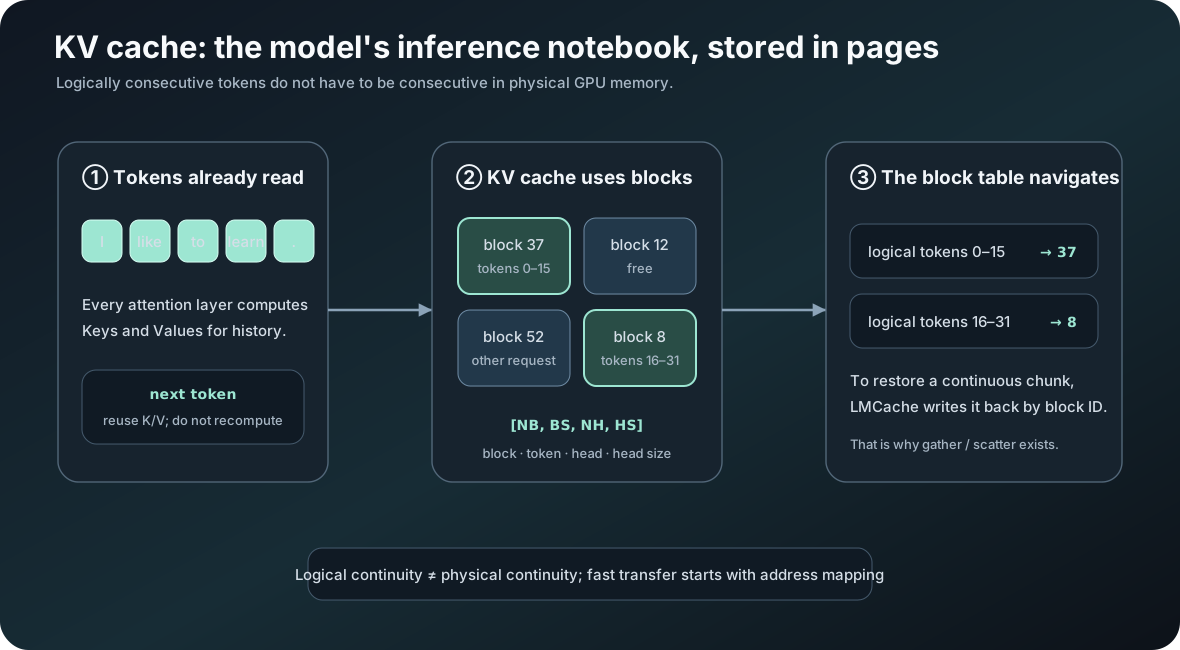
Figure 1: KV cache is the model's inference notebook. After paging, logically consecutive tokens may live in non-consecutive physical blocks.
1. Starting from zero: what is KV cache?
When a language model generates the next token, it attends to tokens it has already read. Every attention layer computes a Key and a Value for each historical token. Recomputing all previous Keys and Values after every new token would create more and more duplicate work as the sequence grows.
KV cache saves those results:
read token → compute K/V → store them in KV cachegenerate next token → reuse old K/V and compute only the new token
Think of KV cache as the model’s inference notebook. The model consults notes it has already written instead of rereading the whole book.
That notebook is large. A serving system runs many requests while their caches grow, finish, and release memory. Requiring one continuous GPU allocation per request would quickly fragment memory. Engines such as vLLM and SGLang therefore divide KV cache into fixed-size pages, also called blocks.
A common physical shape is:
[NB, BS, NH, HS]NB = Number of BlocksBS = Block Size, or tokens per blockNH = Number of KV HeadsHS = Head Size
For example, [96, 16, 8, 128] means 96 blocks, 16 tokens per block, 8 KV heads per token, and 128 elements per head.
A request sees logical tokens 0, 1, 2, and so on. The GPU may place them in physical blocks 37, 8, and 52. A block table connects the two views:
That is why LMCache cannot restore a chunk by copying the entire engine KV pool. It must follow block IDs and place each part into the correct page.
2. Why does LMCache move KV cache?
LMCache extends an inference engine’s local GPU KV cache into CPU memory, storage, or a remote cache. When a shared prefix appears again, the engine can retrieve previously computed KV instead of repeating the full prefill.
In multiprocess mode, the two directions can be simplified as:
STORE / D2H: gather data from the engine’s paged GPU KV cache into an LMCache pinned-host object.
RETRIEVE / H2D: read an LMCache object and scatter it back into the engine’s selected GPU blocks.
H2D versus D2H is not the hard part. The hard part is that the two sides use different memory organizations: LMCache objects follow continuous tokens, while the engine cache follows scattered pages.
3. The general route: staging copy plus block-transfer kernel
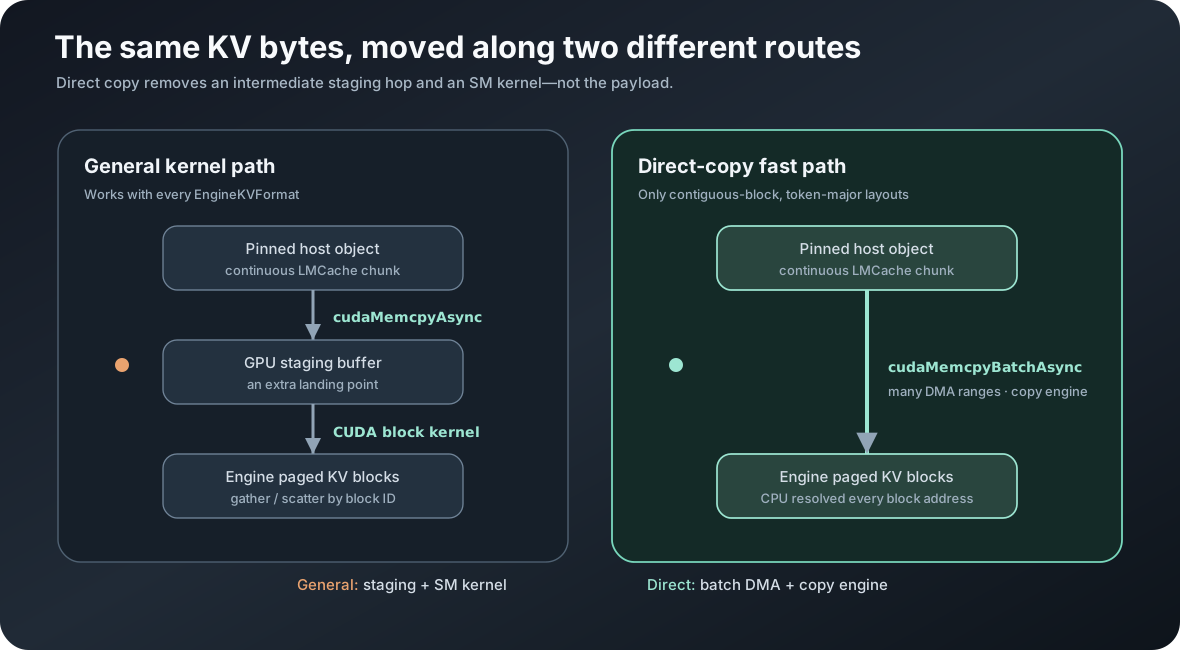
For retrieve, LMCache first copies the continuous object into a GPU staging buffer. A CUDA kernel then reads block IDs and scatters staging tokens into paged blocks. Store performs the reverse gather.
This route supports complex layouts. Even when the byte order inside an engine block differs from LMCache’s token-major object order, a kernel can calculate every token/head address and perform the required reordering.
The costs are also clear:
a temporary GPU buffer;
two movement stages for the same data;
a CUDA kernel launch;
SM usage that can compete with model prefill and decode work.
4. The shorter route: copy directly into every page
PR #5308 added a direct-copy path for LMCache-driven transfer. The CPU resolves each source address, destination address, and length, then submits many copies with one cudaMemcpyBatchAsync call:
Figure 2: Direct copy is not a faster kernel. It removes the staging buffer and kernel, then submits a DMA batch to the copy engine.
Two GPU resources matter here:
Streaming Multiprocessors (SMs) execute CUDA kernels and are also used by model computation.
Copy engines perform DMA and can overlap with some computation.
Direct copy does not reduce the final byte count. It removes an intermediate landing point and the scatter/gather kernel.
There is a hard requirement: each paged block must be one continuous byte range in the same token-major order used by the LMCache object. Only then can one memcpy entry represent “copy this block” without a reordering kernel.
This is why NHD versus HND matters:
NHD: [Block Size, Num Heads, Head Size] all tokens of a block are laid out together → one contiguous copyHND: [Num Heads, Block Size, Head Size] token-oriented transfer may be split across heads → not always one copy
Direct copy is not a user policy knob. LMCache selects it automatically when the build, driver, and every kernel group in the object group qualify; otherwise it safely falls back to the kernel route. CUDA needs runtime and driver support for the CUDA 12.8 batch-copy API. The ROCm/HIP route additionally requires an explicit opt-in and host-pointer capability checks.
5. What SGLang unified MP changes
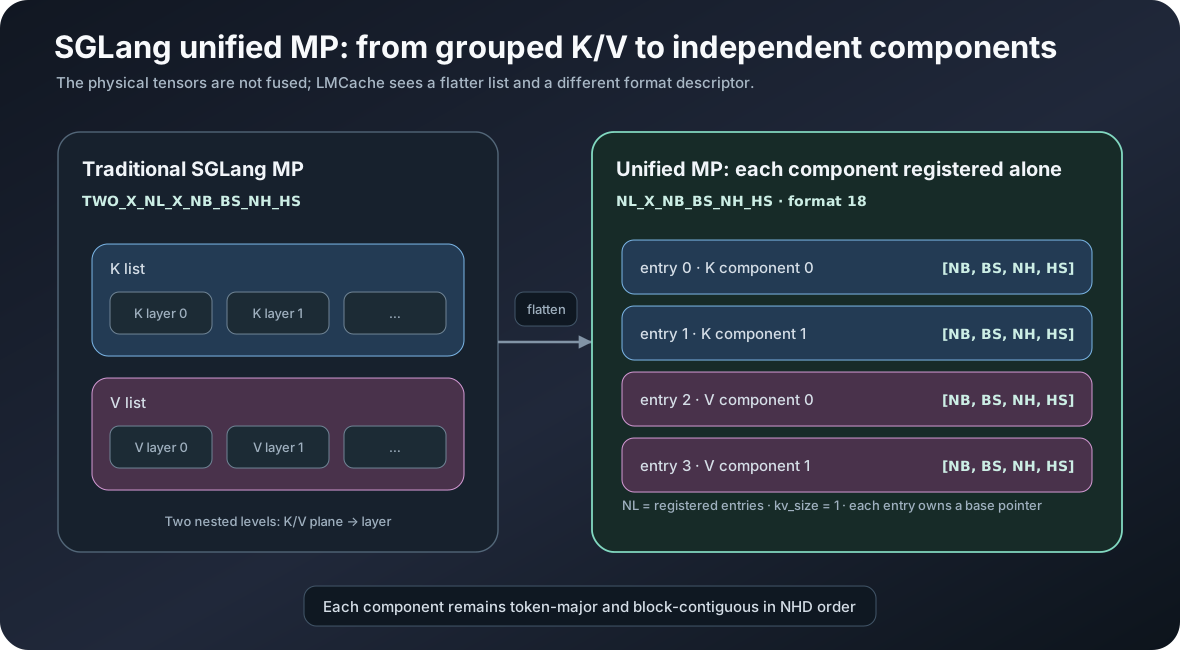
SGLang’s unified KV cache lets different cache components share one management framework. For ordinary MHA, K and V remain separate physical allocations. Unified MP registration flattens them into a list of independent tensors.
Every component is an [NB, BS, NH, HS] tensor. LMCache describes it with EngineKVFormat::NL_X_NB_BS_NH_HS, enum value 18.
Figure 3: Each format-18 list entry is an independently allocated K or V component. NL counts registered entries here; it need not equal the model's logical layer count.
The format name is easier to read with two rules:
_ separates dimensions inside one tensor.
_X_ separates levels across a Python list.
Therefore, NL_X_NB_BS_NH_HS means “a list whose tensors each have shape [NB, BS, NH, HS].”
Most importantly, format 18 treats every K or V component as an independent entry, so its kv_size is 1. There is no additional K/V axis to address inside the tensor.
6. Why one case is enough
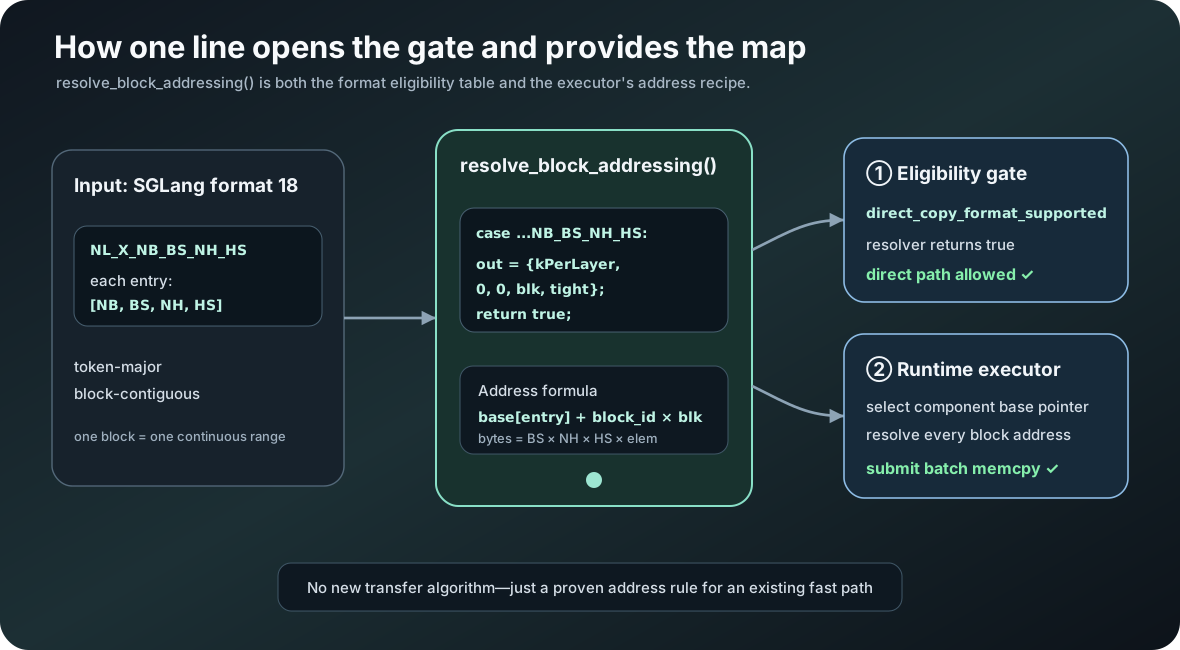
The direct-copy executor does not want to branch on the layout for every copy entry. It calls resolve_block_addressing() once and converts a format into this affine recipe:
case EngineKVFormat::NL_X_NB_BS_HS:case EngineKVFormat::NL_X_NBBS_ONE_HS:case EngineKVFormat::NL_X_NB_BS_NH_TWO_HS:case EngineKVFormat::NL_X_NB_BS_NH_CS:case EngineKVFormat::NL_X_NB_BS_NH_HS: // added out = {B::kPerLayer, 0, 0, blk, tight}; return true;
{B::kPerLayer, 0, 0, blk, tight} means:
Field
Value
Meaning
base
kPerLayer
use each component’s own base pointer
KV stride
0
there is no extra K/V plane inside a tensor
layer stride
0
components do not need a fixed stride; every entry has its own pointer
block stride
blk
block b begins at base + b × blk
copy bytes
tight
copy BS × NH × HS × element_size bytes
The actual format-18 formula is therefore simple:
block_address(component, b)
  = component_base_pointer
  + b × BS × NH × HS × element_size
Figure 4: The same resolver acts as the eligibility table and the runtime stride recipe, so one case both opens the gate and tells the executor how to copy.
Why did the missing line not corrupt data before this PR? The existing block-transfer kernel already handled format 18 in calculate_engine_global_offset(). What was missing was the direct-copy address table, not basic transfer support.
The behavior before and after is:
Before: format 18 → direct copy does not recognize it → kernel fallback → correct, but with an extra hopAfter: format 18 → valid BlockAddressing → batched memcpy → correct, with a shorter path
7. Why the tests are much longer than the production change
The danger in table-driven code is that a line can look obvious while falsely declaring a layout contiguous. A wrong address formula may not produce a clean exception; it may silently corrupt KV cache.
PR #6062 therefore adds two GPU test layers:
Native executor parity: construct a format-18 [NB, BS, NH, HS] geometry and compare direct copy against the kernel reference in both store and retrieve directions, bit for bit. The eligibility table is checked too.
Planner end-to-end parity: create a real GPUCacheContext with EngineType.SGLANG and kv_list_layout=unified, verify that detection produces format 18, then exercise both routes through the public transfer_kv_per_object_group() entry point.
The planner test also covers skip_first_n_tokens. During retrieve, this protects prefix GPU blocks shared through APC and potentially read by other requests from being overwritten.
The test-to-production ratio is not waste. The tests prove that this one-line eligibility declaration satisfies its hidden memory-contiguity contract.
8. How to think about performance
Direct copy is not universally faster. Every (kv, layer, block) needs a batch entry, and CPU submission has a cost. The existing H200 design measurements estimate roughly 0.6 microseconds per entry and a break-even point near 34 KB per entry. Blocks as small as 4 KB or 16 KB can lose to the kernel path.
The path is most attractive when:
blocks are large;
the block count is small;
GPU SMs are busy with prefill or decode;
each physical block is contiguous in the same token-major order.
The original direct-copy work reduced a 128k-token store for Kimi Linear’s 1.1 MB blocks from 26.6 ms to 19.7 ms per rank. That explains why the framework exists, but it is not a performance result for #6062 or for SGLang format 18. This PR contributes path coverage and bit-exact correctness tests, not a new SGLang benchmark.
9. The entire PR in four sentences
Once KV cache is paged, LMCache must gather or scatter according to a block table.
The general kernel route supports every layout but adds a staging buffer and CUDA kernel.
SGLang unified MP format 18 is a token-major, block-contiguous [NB, BS, NH, HS] layout, so it qualifies for direct copy.
resolve_block_addressing() is both the eligibility test and the address recipe; one new case lets the existing framework select the shorter copy-engine route automatically.
That is how a pull request with one production line can still touch KV cache, paging, tensor layouts, CUDA copy engines, multiprocess planning, and a serious correctness contract.